Lessons and Commitments (3/7) - On rent-seeking and self-respect
“To assign unanswered letters their proper weight, to free us from the expectations of others, to give us back to ourselves—there lies the great, the singular power of self-respect."

The other day I sent a message I didn’t need to send to someone I care about. It wasn’t necessarily dishonest. It was just very calculated. I reread it, tightened a sentence, hit send, and then checked my phone multiple times. Nothing important was at stake, I just wanted a certain reply: quick, affirming and respectful. So I engineered the message to pull that out of of the other person. Worse, I felt oddly irritated, like the world was withholding something I’d earned.
I hadn’t felt like that in a long time and it made me feel bad about myself. Not because I’m some pure creature who never calculates, but because that hasn’t been my default. Most of the time I like the way I move through the world: positive-sum by instinct, genuinely curious, usually motivated by a real love for people and ideas. This has helped me feel content about my life, no matter how much or little I have. I carry myself with a sense of assurance that I feel like I had earned by being simple and trying really hard to be good and lead a meaningful, interesting life with good and interesting people. This was the opposite. It felt like I’d stepped outside myself for a cheap hit of reassurance.
I sat with the shame for a bit and tried to trace it back. I wasn’t necessarily ashamed of being “strategic.” It was that I’d tried to extract a feeling: respect or maybe affirmation from someone else without being vulnerable. It pointed at something as simple but insidious as rent-seeking.
Rent-seeking, in the broadest sense, is a sin that robs you of far more than you gain in the short term. It is a sin because you might harm others, but more importantly, you betray yourself in the act.
I got a taste of this young. I’d won a debating tournament and our team got invited to receive the prize from a well-known politician. It wasn’t the usual after-school tournament I’d do with my friends. This was an international European thing, glossy and unmistakably status-driven. The whole night had that atmosphere where you can feel the hierarchy before anyone says anything. Who gets pulled close. Who gets spoken over. Who laughs a little too quickly. Older politicians were studying us like a new crop, kids who might someday matter in the social currency they cared about.
We were teenagers who’d spend hours after class researching and arguing big, uncomfortable questions, like abortion, like whether privacy should ever be traded for “security.” We told ourselves we were truth seekers. And still we were starstruck. We started nodding along to everything. I did it too at first. I was polite in that extra careful way, like I was auditioning to be “a smart kid who’d go on and do great things.” Then I felt this jolt of embarrassment at how fast I’d shifted. How quickly my personality had turned into agreeableness and how small I made myself.
I remember the moment I stopped playing along. He said something about the debate that hit a nerve, and it shocked me coming from someone like him. I pushed back. He wouldn’t let it go. He kept pressing and defending, and I kept pressing back. The room changed on the spot. I could tell I’d broken an unspoken rule. It quickly diffused and I honestly don’t think anyone really cared that much at the end of the night but it left me shaky.
Afterward my teammates told me they were glad I’d said something. I remember walking to my host family’s house in this foreign country stressed and anxious, mostly because I didn’t know how to navigate rooms like that yet, and I could see I’d be in more of them as I got older. What I do remember, vividly, is the feeling that I didn’t want to live by those rules, consciously or subconsciously. I also remember that I felt like I had earned my own respect, and it felt far more rewarding then the cheap nods and approvals I would get at the dinner when I would say something interesting.
I want to preface this by saying that this is not written from any moral high ground. It is an observation, a trap that even well-meaning people fall into because many environments reward it.
I finally found a name for the impulse in an economics class: rent-seeking. In economics, it means gaining wealth or advantage without creating new value. In life, it’s the urge to collect rewards like attention, belonging, or validation without really earning them. It feels good for a moment, and then it leaves you emptier.
You start to see it everywhere once you start looking.
It is the team member who takes credit for a project they barely touched, the friend who keeps score in every interaction no matter how many times you have extended grace, support and good intent, or the artist who borrows a movement’s language to seem relevant without believing in it. It is the founder who spends more time optimizing their public image on Twitter than improving the product. It shows up in softer ways too: chasing proximity to intelligence instead of doing the slow work of becoming intelligent, finding a true interest and becoming truly good.
Sometimes it hides inside good intentions. Wanting to be included is normal. Wanting to be heard is normal. Wanting to belong is normal. The shift happens when those desires turn into a transaction. When you start treating relationships, work, and even creativity as something to extract instead of something to participate in.
I have seen some version of this everywhere I’ve spent time: art circles, founders, elders, farmers, researchers, self-described idealists and pragmatists alike. It doesn’t always look selfish. Sometimes it looks like ambition, sometimes like insecurity, sometimes like being tired. But the vibe is the same: people wanting the benefits of being close to something good without really stepping into the work that makes it good.
When I see people complain about the culture in San Francisco, I think they mean that some corners have normalized rent-seeking to the extent that it is no longer noticed when done. But just because many people do it does not make it harmless. It cheapens friendship, it cheapens generosity and it cheapens the pursuit of grand ideas. I miss the simplicity of where I grew up for that reason. People could be complicated, even difficult, but motives were easier to read because we were simple people. When someone was kind, it usually just meant they were kind. And even when someone was acting badly, it was clearer that this came from ignorance or from pain. There was little strategy.
It is never acceptable to rent-seek in friendships or work. When you create or connect sincerely, you extend small antennas that guide you toward growth. Rent-seeking cuts that signal off. Even in short encounters, I want to make sure I always resist the urge to extract without giving. And most definitely never rent-seek from those who are more vulnerable.
In intellectual or creative work, rent-seeking becomes even more insidious because it disguises itself as ambition. You start asking, How can I own this idea or gain from it? instead of How can this idea best serve its purpose? That subtle shift changes everything. Creation becomes a performance for an audience who will never be satisfied. Progress slows down because everyone is guarding rather than building.
We are vessels, not finished projects that need to be admired in a polished clean museum. I deeply believe that our role in this world is to move things forward so that more of what is good will be created.
Lately, I have been thinking about self-respect as the antidote to this rent-seeking impulse. Joan Didion wrote:
“To assign unanswered letters their proper weight, to free us from the expectations of others, to give us back to ourselves—there lies the great, the singular power of self-respect. Without it, one eventually discovers the final turn of the screw: one runs away to find oneself, and finds no one at home.”
Some of the people I admire most seem to live by that quiet creed. They do not perform care, they practice it. They do not seek validation but are instead doing what they enjoy or believe is the right thing for as long as is needed. And ultimately, this allows them to come home to something real.
I am not preaching or virtue-signaling here. These are just threads I have been sparring with for years, and writing them out is my attempt to see them more clearly.
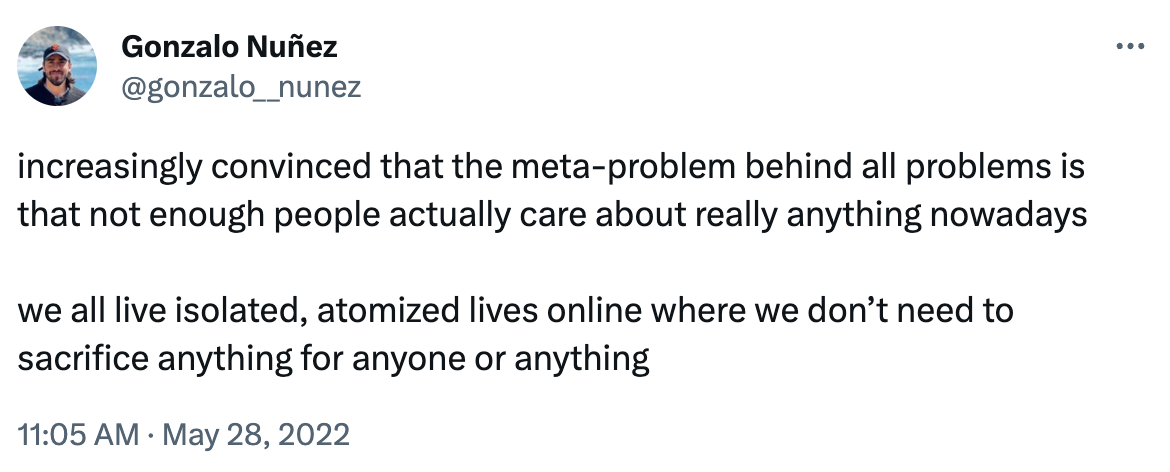
I have reread Gonzalo’s thoughts on this topic several times. He argues that people simply do not care enough, but I suspect the cause runs deeper. Most people I meet do care and want to be let by the good and abundance in them, yet they feel stuck. Reading Didion’s essay struck a chord because it reframes the issue: the problem is not apathy, it is the erosion of self-respect.
Cultivating consistent self-respect is difficult, especially in a world that is relentlessly digital and a marketplace first. The Poshmark logic gets applied to identity too: you list your traits, polish the photos, learn which angles sell, rewrite your bio until it converts. Even “values” start to read like tags. On top of that, the standards keep moving. There are endless moral frameworks and theories of a good life, and you can pick a new one every week. Very few are taught with any depth, and even fewer are mirrored back to you by people who actually live them.We have less and less village elders that live by example or livingly but firmly correct this youthful impulse. It seems worthwhile to ask how we might rebuild self-respect, both individually and culturally.
In many collective cultures, people still spend time instilling virtue and self-trust, which as a side effect builds self-respect. My grandfather used to take me to his little neighborhood farm to teach me that boring, repetitive labor matters. He’d have me dig up potatoes during Dutch summers some of which could actually be really hot, which, for my weak body, was genuinely hard. But he wouldn’t let me quit. When I’d finally pushed myself far enough, he’d laugh at how much I’d struggled and say, “See? You’re in a flow now, aren’t you?” Then he’d send me off for a cup of tea and tell me to wash the dirt off my hands.
My martial arts coach never let us quit a match early, even when we were intimidated. He would say, Pain is just pain. As long as it is not bleeding, you do not stop. Those lessons felt harsh then, but I see now they were training self-respect through discipline. I wasn’t thinking about what others could do for me, or what they “should” be doing for me. I was too busy doing the doing. The fun parts, the tedious parts, all of it. And that made me lighter and trust myself more,
Modern culture often reduces self-respect to therapy slogans: just drop them, protect your energy, set boundaries. I worry how the algos have stripped away intuition and insights you have to earn by experiencing them, not by intellectualizing and coming up with a clean, calculated rule for how you want to behave and how you want to interact with others. Boundaries are important, but self-respect is not just about withdrawal. It is also about endurance, contribution, and the courage to stay when something is worth staying for. It is about earning your own trust through consistent action.
To me, self-respect feels like the opposite of rent-seeking. It is showing up as a builder and to know you would be okay with not collecting anything from anyone/anything. It is to pour so much into the world because you believe you are able to give endlessly, and to be deeply aware of the limited time and flaws we all have. It is being grounded enough to know what you stand for but flexible enough to be open to course-correct and face the difficult parts about yourself.
I want to invest even more in what consistent self-respect looks like. Maybe it begins with ruthless discipline and repetition, generosity, and 100% truth-telling. I think I already do a decent job at showing up and not extracting but there is much more work to be done. There is probably also a lot of grace to yourself and others involved.
Thank you for reading my musings! I love the writer corner of the internet and want to be part of it :)
As a token of digital friendship, here is an artist I’d love to share with you!